
3x − 7
=2x + 5
− 2x
x − 7
=5
+ 7
x
=12
Math
Algebra
Linear equations, functions, systems, and inequalities — roughly 35% of the Math section and the domain that rewards practice most reliably.
5 lessons5h70 questions
Interactive Desmos demos you control step by step, live SAT questions with hints and explanations, and 10 vocab cards you can flip. Everything on this page is exactly what's inside the paid course — just a smaller slice of it.
Nothing plays on its own. Press Next step, drag the tracer and the sliders with your own hand, then answer the question at the end — the exact workflow you'd use on test day.
Inside the course every domain gets its own lab — Algebra, Advanced Math, Geometry & Trigonometry, and Problem-Solving & Data Analysis.
y = 0.5x² − 2 is on screen. Desmos graphs as you type; you never rearrange anything.
Desmos Mastery is a full 9-lesson track bundled free with the course. Every lesson is one screen, one workflow, and a timed before/after — these are three real lessons pulled straight out of it.
Desmos Mastery — 42+ timed workflows, bundled free
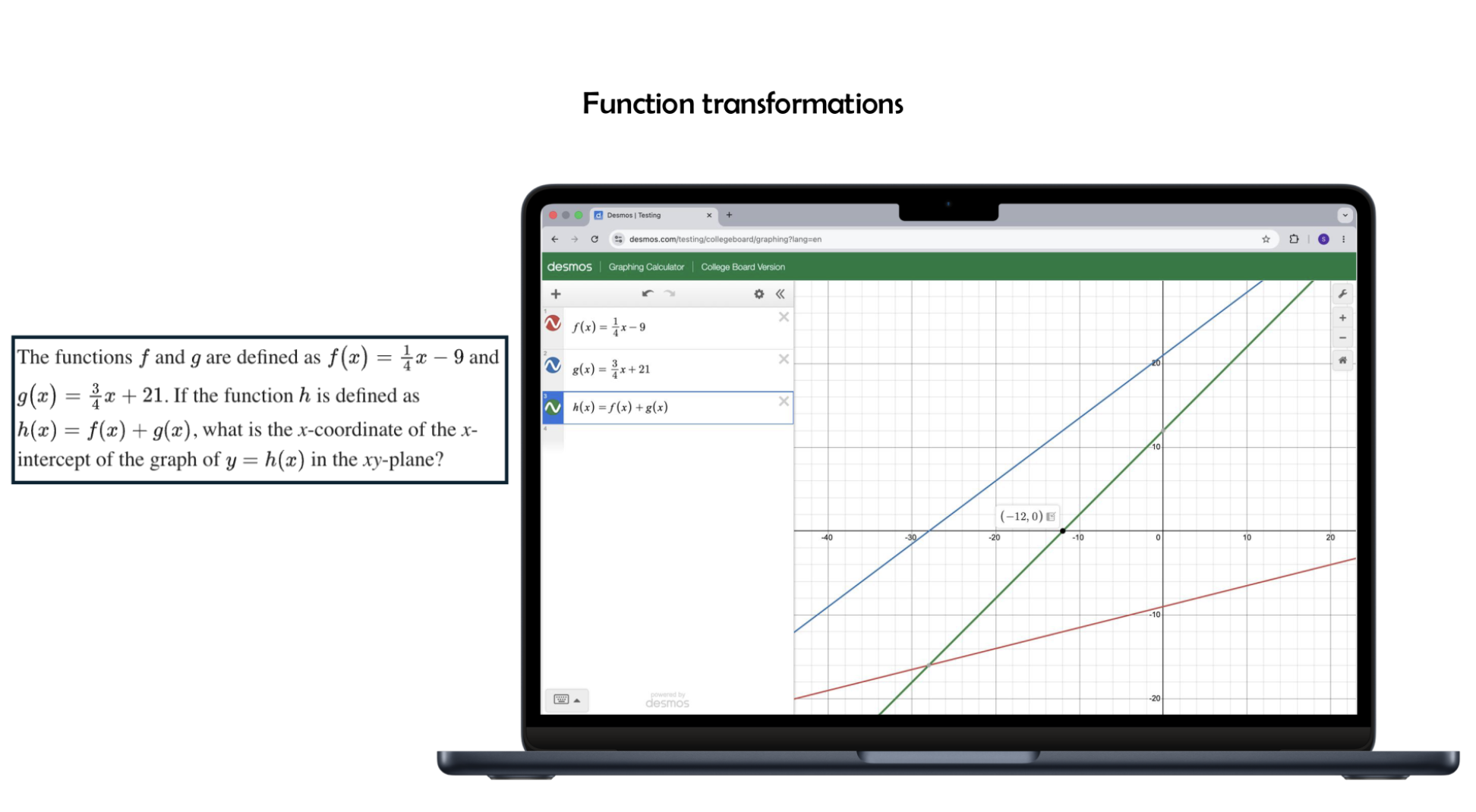
Type f, type g, define h = f(x) + g(x), then click the x-intercept.
You've seen 3 of 42+ timed Desmos workflows — here's what unlocks with the full course
The free demo shows three workflows. The full Desmos Mastery track is 9 lessons, 42+ timed workflows, full regressions for every curve type, and a drill set for each one — bundled free when you enroll.
This is the structure of the paid course — eight domains, each built around an animated visual model, with lesson counts and question counts you can expand.
Linear equations, functions, systems, and inequalities — roughly 35% of the Math section and the domain that rewards practice most reliably.
Equivalent expressions, quadratics, exponentials, and nonlinear systems — the other ~35% of Math, and where higher scores are won.
Ratios, percentages, statistics, probability, and study design — about 15% of Math, and the domain most tied to real contexts.
Angles, triangles, circles, volume, and right-triangle trig — about 15% of Math, with a reference sheet provided on test day.
Central ideas, textual and quantitative evidence, and logical inference — about 26% of the Reading & Writing section.
Vocabulary in context, rhetorical purpose, and comparing paired texts — about 28% of the Reading & Writing section.
Rhetorical synthesis and transitions — about 20% of the Reading & Writing section, and among the most learnable question types.
Punctuation, sentence boundaries, agreement, and modifiers — about 26% of Reading & Writing and the most rule-governed material on the test.
Same layout as the paid bank: passage on the left, question on the right, a hint button that teaches the trick without giving away the answer, and a bulleted explanation afterward.
When self-checkout kiosks first spread through grocery chains, economists widely predicted a steep drop in cashier employment. A 2023 study of 1,400 stores, ______ found that cashier headcount had barely changed: managers had reassigned staff to floor support and order fulfillment rather than eliminating positions.
Which choice completes the text with the most logical transition?
Tap any choice to see why it's there. The traps are labelled — that's how the explanations work inside the course, so you stop losing points to the same three habits.
In her memoir, the diplomat describes negotiations that dragged on for months without visible progress. Yet she insists the delay served a purpose: each side needed time to abandon positions it had adopted for domestic audiences rather than out of genuine conviction. The apparent stalemate, she writes, was ______ — a necessary interval during which unrealistic demands quietly expired.
Which choice completes the text with the most logical and precise word or phrase?
Ten sample cards here, drawn from the 384-card deck inside the course — every word chosen because it actually repeats on the Digital SAT.
The full deck inside the course has all 384 cards.
Same content, no scheduling, no hourly meter. Pay once and the whole course — every lesson, question, flashcard and future update — stays yours.
Short answers, no sales pitch.
Yes — only the digital SAT. Every question uses the current formats, the practice tests are built in the real module structure, and there's a whole section on the Desmos calculator that ships with the test. Nothing here is left over from the paper exam.
Before the full slice
Grammar & punctuation — periods, semicolons, colons, commas and dashes — then 6 real questions with hints and full explanations.
Grab a notebook first — take notes on each rule as you go.